
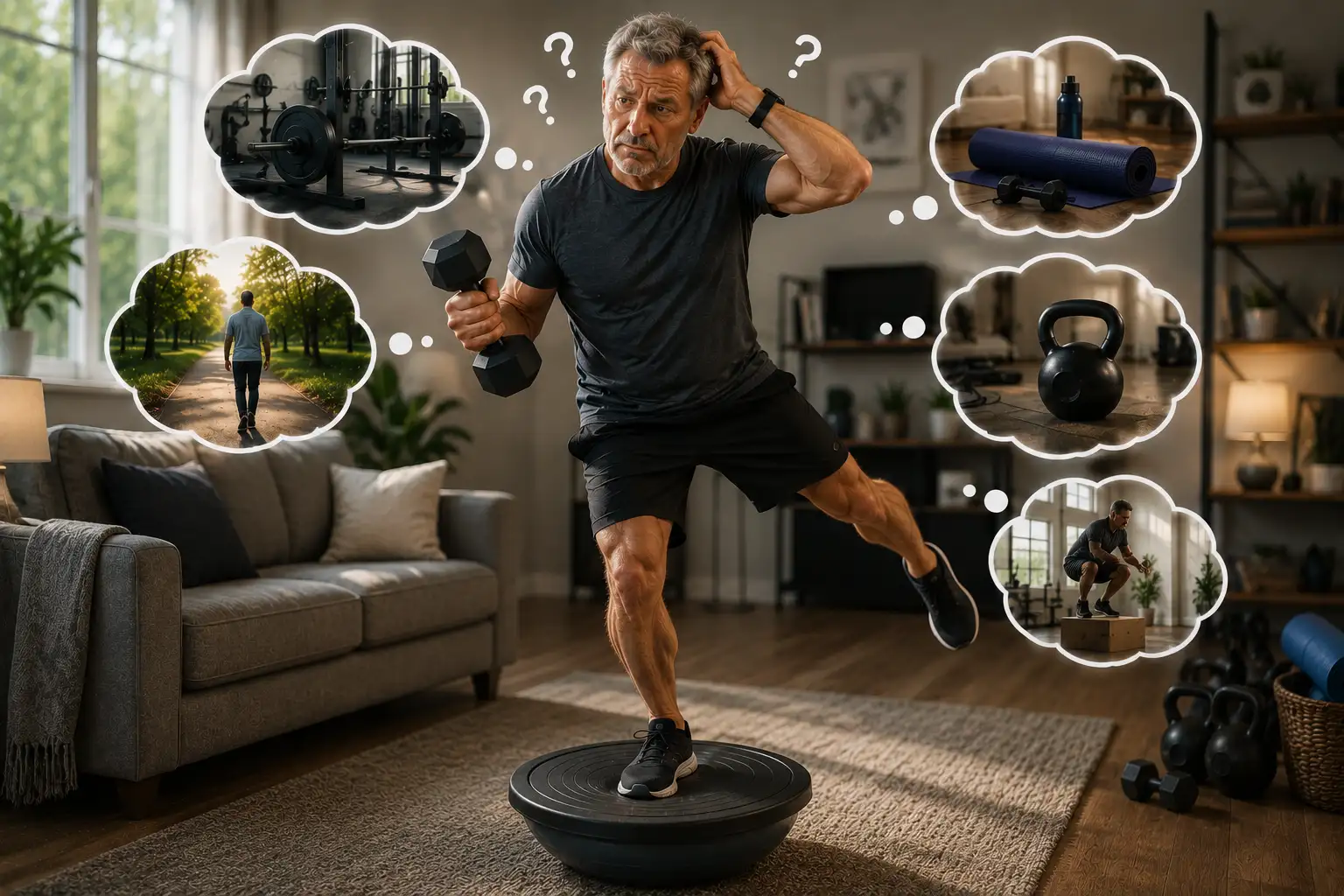
Forget chasing the perfect workout. If your goal is to stay strong, mobile and independent as you get older, what you train may matter more than how impressive your workout looks.
We often think of exercise in terms of weight loss, building muscle or improving athletic performance. But there is another goal that deserves more attention: healthspan—the number of years you can live while staying strong, active and independent.
So, what should we actually train for healthy aging?
🏋️ 1. Keep Your Muscles Strong
As we get older, we naturally lose some muscle mass and strength. This process can become more significant and is sometimes referred to as sarcopenia—the age-related loss of muscle strength, muscle mass and physical function.
In simple terms, sarcopenia means becoming gradually weaker and less physically capable as we age. It can eventually make everyday activities such as climbing stairs, getting out of a chair, carrying groceries or recovering from a stumble more difficult.
Importantly, sarcopenia isn’t simply about having smaller muscles. A decline in muscle strength can be particularly important and may occur even before there is an obvious change in muscle size.
Recent research continues to support resistance training as a key component of healthy aging. A 2026 systematic review and meta-analysis found that exercise, particularly resistance and multicomponent exercise, improved muscle-related outcomes and physical performance in older adults with sarcopenia.
Translation: Your future self needs you to lift some weights today.
And you don’t necessarily need a fancy gym. Squats, step-ups, rows, presses, carries and resistance-band exercises can all be useful starting points.
❤️ 2. Train Your Heart and Lungs
Being strong is important—but so is being able to walk up several flights of stairs without feeling completely exhausted.
Cardiorespiratory fitness is strongly associated with health outcomes, and newer research continues to investigate its relationship with cognitive and mental health.
A 2026 systematic review and meta-analysis found that higher cardiorespiratory fitness was associated with a lower risk of dementia, although the certainty of evidence varied and these associations do not prove that fitness alone prevents dementia.
This is where activities such as brisk walking, cycling, swimming, jogging or other aerobic exercise come in.
You don’t need to become a marathon runner.
You need a cardiovascular system that can handle the demands of everyday life.
⚡ 3. Don’t Forget Power
Here’s something people often overlook:
Strength and power aren’t the same thing.
Strength is your ability to produce force.
Power is your ability to produce that force quickly.
As we age, the ability to react quickly can become particularly important—for example, catching yourself when you trip or getting up quickly from a chair.
That means longevity training shouldn’t only involve slow, controlled exercises. When appropriate and safely progressed, training can also include faster movements such as sit-to-stands, step-ups, medicine-ball exercises or controlled jumping.
The goal isn’t to become an Olympic athlete.
It’s to keep your body capable of responding when life suddenly demands it.
🧠 4. Train Your Brain While You Move
Your brain and body don’t operate separately.
A fascinating 2026 systematic review involving 1,097 older adults with mild-to-moderate cognitive impairment or dementia found different benefits from different exercise types. Aerobic exercise was mainly associated with cognitive benefits, resistance exercise with improvements in strength and physical performance, while combined programs showed benefits across both areas.
This opens the door to something very interesting:
Don’t just train your muscles. Challenge your brain while you move.
Try walking while performing a simple mental task, changing direction in response to a signal, catching a ball while balancing, or performing movement sequences from memory.
This is sometimes called dual-task training—performing a physical and cognitive task at the same time.
🧍 5. Train Balance and Movement, not Just Muscles
Longevity isn’t about how much you can bench press.
It’s also about whether you can:
- Get up from the floor
- Carry your groceries
- Climb stairs
- Walk confidently on uneven ground
- Turn quickly without losing your balance
- Pick something up from the floor
- Play with your grandchildren
- Travel without worrying about your physical abilities
That’s why a well-rounded longevity program should include strength + aerobic fitness + balance + coordination + functional movement.
Research on resistance circuit training in older adults has also found improvements in strength, lean mass, cardiorespiratory endurance and functional ability, supporting the idea that exercise doesn’t have to be complicated to be useful.
So, What Does a “Longevity Workout” Look Like?
It doesn’t have to be complicated.
A week could include:
🏋️ 2–3 days: Strength training
❤️ 3–5 days: Walking, cycling or other aerobic activity
⚡ 1–2 days: Appropriate power/speed exercises
🧍 Regularly: Balance and mobility work
🧠 Occasionally: Cognitive + movement challenges
And perhaps the most important ingredient?
Consistency.
You don’t need the perfect program. You need a program you can continue doing for years.
The Goal Isn’t to Live Forever
The goal is to make your 60s, 70s, 80s and beyond as active, capable and independent as possible.
And that’s a very good reason to start training today.
References
- Exercise interventions for sarcopenia in older adults: a systematic review and meta-analysis. Scientific Reports. 2026.
- Cardiorespiratory fitness and risk of mental disorders and dementia: a systematic review and meta-analysis. Nature Mental Health. 2026.
- Effects of exercise modalities on cognitive and muscle function in older adults with cognitive impairment: a systematic review and meta-analysis. Scientific Reports. 2026;16:19319.
- Hu C, Xia Y, Zeng D, et al. Effect of resistance circuit training on comprehensive health indicators in older adults: a systematic review and meta-analysis. Scientific Reports. 2024;14:8823.