
If you’ve ever had pain on the outside of your knee or hip, there’s a good chance someone has told you:
“Your IT band is tight. You need to foam roll it.”
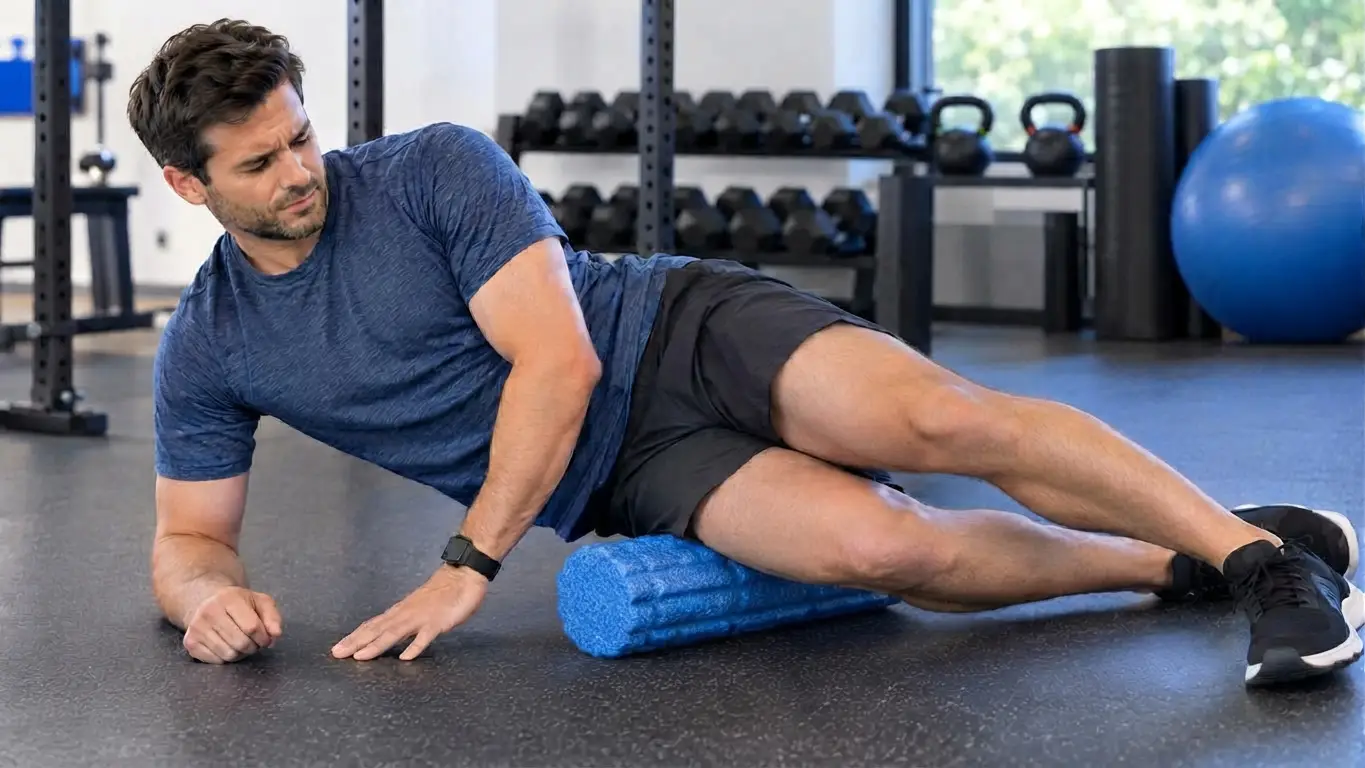
So you grab a foam roller, lie on your side, and slowly roll up and down the outside of your thigh.
It hurts.
A lot.
And then someone tells you:
“That’s how you know it’s working.”
But is it?
The answer is a little more interesting than a simple yes or no.
First: foam rolling can actually do something
Let’s be fair to the foam roller.
Research does show that foam rolling can have short-term effects on mobility. A systematic review found that self-myofascial release using a foam roller or roller massager can temporarily increase joint range of motion without negatively affecting muscle performance. It may also help with some aspects of post-exercise soreness and recovery.
A larger systematic review and meta-analysis involving 26 trials also found that foam rolling produced acute improvements in range of motion compared with no exercise. Interestingly, foam rolling was not superior to stretching.
So no—foam rolling isn’t useless.
But there is an important question:
What exactly are you changing when you roll?
Your IT band isn’t a muscle
The iliotibial band, or IT band, is a thick band of connective tissue running along the outside of your thigh from the hip toward the knee.
It isn’t a muscle that you can simply “stretch out” like your hamstring or quadriceps.
This is where some of the common foam-rolling explanations become misleading.
You may hear that rolling your IT band:
- “breaks up adhesions”
- “releases scar tissue”
- “loosens the IT band”
- “breaks down knots”
- or physically lengthens the IT band
The evidence doesn’t give us good reason to confidently make those claims.
Foam rolling can change how you move or how sensitive a particular area feels without necessarily physically lengthening or restructuring the tissue you’re rolling.
That’s an important distinction.
So why can foam rolling feel helpful?
One possibility is that foam rolling changes how your nervous system responds to the area being treated.
In simple terms, you may temporarily become more comfortable moving through a certain range.
That can be useful.
For example, if foam rolling helps you feel less stiff before a workout or gives you a temporary improvement in movement, there’s nothing inherently wrong with using it.
But temporary symptom relief is not necessarily the same thing as fixing the underlying problem.
And this is especially important when we’re talking about pain on the outside of the knee.
What if you have IT band pain?
This is where things get more interesting.
If you have pain around the outside of your knee while running, cycling, hiking, or going up and down stairs, repeatedly attacking the painful area with a foam roller may not be the most important part of your recovery.
Instead, we should ask:
Why is this area becoming painful in the first place?
Your symptoms may be influenced by things such as:
- A sudden increase in running or training volume
- Repetitive loading
- Changes in your training surface
- Reduced strength or load tolerance
- Hip and lower-limb mechanics
- Changes in activity after a period of inactivity
- Insufficient recovery
- Previous injuries
- A sudden increase in hills, stairs, or other repetitive activities
And importantly, pain on the outside of the knee doesn’t automatically mean that your IT band is “tight.”
There can be different causes of lateral knee pain, so the diagnosis matters.
What does the research actually tell us?
One study specifically looked at foam rolling applied to different portions of the lateral myofascial line and found improvements in hip adduction range of motion. Foam rolling applied to the upper portion of the lateral line produced a significant improvement compared with the control side.
That’s interesting—but notice what the study measured:
Hip range of motion.
It did not show that foam rolling cured IT band syndrome or permanently changed the structure of the IT band.
Similarly, the larger foam-rolling literature supports short-term changes in range of motion, but that doesn’t automatically mean the tissue has been permanently “loosened.”
So the evidence is actually quite reasonable for saying:
“Foam rolling can have short-term effects.”
It’s much harder to say:
“Foam rolling fixes your tight IT band.”
Those are two very different statements.
Should you stop foam rolling your IT band?
Not necessarily.
This is not an article telling you to throw your foam roller away.
If you enjoy foam rolling and it helps you feel better, move more comfortably, or prepare for exercise, it can be a useful tool.
The problem is when foam rolling becomes the entire treatment plan.
If your knee hurts every time you run, you probably don’t need to spend more time aggressively rolling the painful area and hoping it eventually disappears.
You may need to improve your body’s ability to tolerate the activity that is provoking your symptoms.
That could mean gradually adjusting your training load, improving strength, working on movement strategies, and progressively exposing the area to the demands of running, cycling, hiking, or sport.
Think beyond the foam roller
Imagine your body is a car.
If the warning light comes on every time you drive up a hill, you could cover the warning light with tape.
The light disappears.
But the problem hasn’t necessarily disappeared.
Foam rolling can sometimes make an area feel better temporarily.
That’s useful.
But if the same pain keeps coming back every time you run, the bigger question is:
“What is causing this area to become overloaded?”
That’s where a proper assessment becomes valuable.
The bottom line
Foam rolling isn’t bad.
In fact, research supports short-term improvements in range of motion and some other benefits from self-myofascial release.
But you don’t need to believe that you’re “breaking up” your IT band every time you roll over it.
And if you have persistent pain on the outside of your knee or hip, repeatedly rolling the painful area may not address the reason the problem developed.
Instead of asking:
“Where can I roll this pain away?”
A better question may be:
“Why is this area having trouble handling the load I’m putting on it?”
That’s where rehabilitation gets more interesting—and much more useful.
At New Life Physio and Health Clinic, our physiotherapists can assess your movement, strength, mobility, training or work demands, and overall load tolerance to help determine what may be contributing to your symptoms. Treatment may include exercise, strength training, movement retraining, hands-on techniques, education, and a gradual return to the activities you enjoy.
The goal isn’t to find the most painful spot to roll.
The goal is to help your body handle the demands you want to put on it.
References
- Cheatham SW, Kolber MJ, Cain M, Lee M. The effects of self-myofascial release using a foam roll or roller massager on joint range of motion, muscle recovery, and performance: a systematic review. International Journal of Sports Physical Therapy. 2015;10(6):827–838.
- Wilke J, Müller AL, Giesche F, Power G, Ahmedi H, Behm DG. Acute effects of foam rolling on range of motion in healthy adults: a systematic review with multilevel meta-analysis. Sports Medicine. 2020;50(2):387–402.
- Simatou M, Papandreou M, Billis E, Tsekoura M, Mylonas K, Fousekis K. Effects of the Ergon® instrument-assisted soft tissue mobilization technique, foam rolling, and static stretching application to different parts of the myofascial lateral line on hip joint flexibility. Journal of Physical Therapy Science. 2020;32(4):288–291.
Frequently Asked Questions
1. Is foam rolling the IT band bad for you?
Foam rolling can produce short-term changes in range of motion and may help some people feel less stiff or more comfortable. However, aggressively rolling directly over the IT band isn’t necessarily going to “loosen” or permanently change the tissue. In some people, especially when the area is already irritated or sensitive, direct pressure may actually aggravate symptoms.
2. Can foam rolling fix IT band syndrome?
There isn’t strong evidence that foam rolling alone fixes IT band syndrome. It may be one tool that helps with short-term symptoms or mobility, but addressing training load, strength, movement, and the body’s ability to tolerate activity is often more important.
3. Why does foam rolling my IT band hurt so much?
The outside of the thigh can be sensitive to direct pressure, particularly when an area is already irritated. More pain doesn’t necessarily mean the treatment is working better. In some cases, repeatedly applying strong pressure to an already painful area may make symptoms worse. You shouldn’t feel that you have to “push through” significant pain while foam rolling.
4. Do I need to stretch or loosen my IT band?
Not necessarily. The IT band is a dense band of connective tissue rather than a muscle that can simply be stretched like a hamstring. If you’re experiencing lateral knee or hip pain, the more important question is often why the area is becoming overloaded or sensitive in the first place.
5. Should I foam roll my IT band if I have pain?
We would recommend not to start aggressively foam rolling a painful IT band without first understanding what may be causing your symptoms. Pain on the outside of the knee or hip doesn’t automatically mean that the IT band is the problem, and in some cases, direct pressure may aggravate your symptoms. Consulting a physiotherapist can help determine the cause of your pain and whether foam rolling—or another approach—would be appropriate for you.